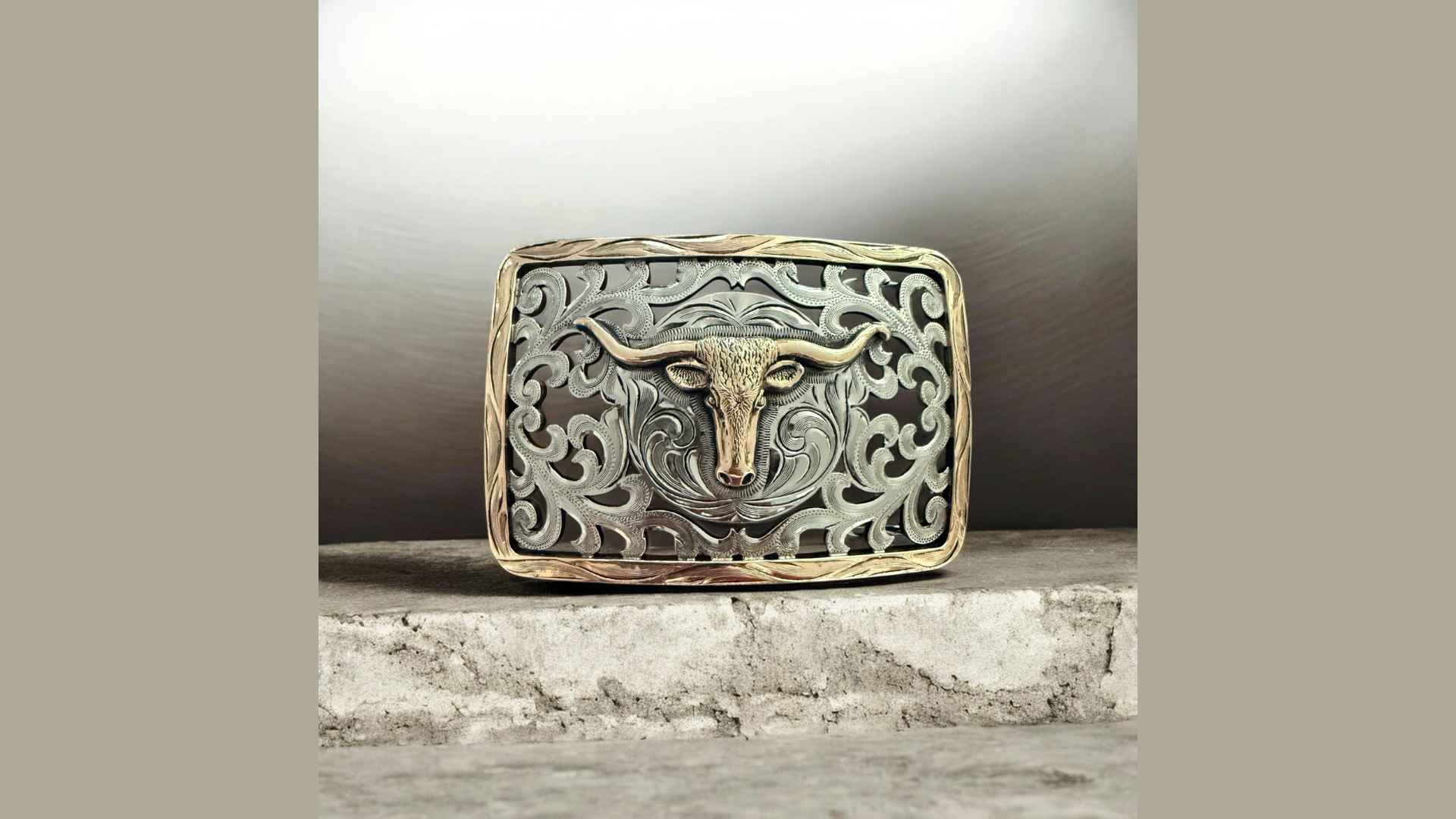
A western belt buckle set is not just a buckle with extras. It is a complete hardware system designed to dress a leather belt from end to end with matched silver pieces that work together visually and functionally. If you have ever looked at a fully outfitted western belt and noticed the silver running all the way to the pointed end, that is a set at work.
This guide explains what a three-piece western buckle set includes, how each piece functions, and how sets differ from a standard single-piece removable buckle.
A standard three-piece western belt buckle set contains a main buckle, a keeper, and a tip. Each piece serves a distinct purpose, and quality sets carry consistent design, finish, and proportion across all three.
The three pieces work as a system. Buy a single buckle and the belt has a functional fastener at the front. Buy the full set and every inch of the belt reads as intentional hardware, not just functional hardware. That distinction is the point of a matched set.
The main buckle is the largest piece and sits at the center front of the belt. It does the functional work of fastening the belt closed, and it carries the primary design detail of the set. In a western buckle set, the main buckle typically runs wider and more detailed than a standard removable plate buckle, giving the engraving, border treatment, or stone work more surface to develop across.
The main buckle connects to the belt through a strap bar on the back, sized to accept a specific belt width. Most three-piece western sets are built for a 1.5-inch belt strap. Wider sets exist for broader belts, and narrower versions suit women's western styles and slimmer dress belts.
The keeper is the middle piece of the set. It slides onto the belt strap and sits a few inches from the main buckle, usually positioned between the first and second belt loop. Its job is practical and visual at the same time.
On the practical side, the keeper holds the loose tail of the belt flat against the main strap after fastening. Without it, the tail flaps, shifts, and pulls the outfit out of alignment. With it, the belt tail tucks through cleanly and stays put.
On the visual side, the keeper carries a scaled-down version of the same engraving and finish as the main buckle. That consistency across pieces is what makes a set read as unified. A keeper that does not match the main buckle tells the eye that the pieces do not belong together, even if the sizing is correct.
Most keepers feature two parallel bars that the belt strap slides through, holding the piece in a fixed position on the leather. Some versions use a single bar and attach at a specific point. Either way, the keeper does not move around on the belt. It stays where it is set.
The tip caps the pointed end of the belt strap. It is the smallest piece in the set and the easiest to overlook, but it completes the look in a way that nothing else does. The pointed end of a leather belt without a tip looks unfinished, regardless of how good the main buckle is.
Functionally, the tip protects the leather end from splitting, fraying, or peeling over time. The leather at the very end of a belt takes more bending and contact than any other part of the strap, and a metal tip covers that stress point completely.
Tips either crimp onto the leather end or slide on and secure with small fasteners from behind. A well-fitted tip sits flush against the leather with no gap, no wobble, and no visible fastener on the face side.
For a full breakdown of how individual belt buckle components are named and how they function, the belt buckle parts, types, and closures guide covers the terminology in detail.
A standard removable western buckle is a single piece. It attaches to the belt at the fold end, fastens the belt closed, and that is the full system. The rest of the belt strap is plain leather.
A western buckle set changes the entire character of the belt. The hardware extends from the main buckle at the front to the keeper holding the tail to the tip at the far end. The leather becomes the substrate that holds the hardware rather than the visual focus of the belt itself.
This difference shows clearly in formal western contexts, show settings, rodeo events, and dress occasions where the complete set signals intentional western style. A single buckle on a plain leather strap suits everyday wear perfectly well. A complete set suits occasions where the full outfit gets attention.
Western belt buckles and tradition reimagined covers how matched western hardware fits into the broader tradition of dressed western style.
The set and the belt have to match in width. A set built for a 1.5-inch strap will not work on a 1.75-inch belt. The keeper bars sit too close together, the main buckle bar cannot accept the wider leather, and the tip will not cover the end correctly.
Measure the belt strap before ordering any set. Common strap widths and the set sizes that match them include:
|
Belt Strap Width |
Typical Set Size |
|---|---|
|
1 inch |
Slim dress or women's narrow sets |
|
1.25 inches |
Women's western and lighter dress sets |
|
1.5 inches |
Standard adult western sets |
|
1.75 inches |
Wide western and statement sets |
Always confirm strap width at the fold end of the belt, not at the holes. The leather sometimes narrows slightly near the tip end, and the fold end measurement is what determines set compatibility.
The metal used in a set determines how it looks, how it ages, and how long it holds up. Three material options appear most often in western buckle sets.
German silver is the most common material in mid-range sets. It is a copper, nickel, and zinc alloy with no actual silver content, despite the name. It holds a cool silver tone and resists tarnishing well. Most production western sets use German silver because it performs reliably at a lower price point than sterling.
Sterling silver is the premium option. It is 92.5% pure silver and carries warmer, richer visual character than German silver. Sterling takes engraving with more depth and definition, and it develops a natural patina over time that deepens the contrast in recessed areas. Sterling sets cost more and require polishing to stay bright, but they age with genuine character rather than simply wearing down.
Two-tone and three-tone combinations layer silver-tone metal with gold, copper, or brass accents. The contrasting tones pull engraving detail forward visually and make border work read more clearly. Multi-tone sets are popular in trophy contexts and anywhere the set is meant to draw clear attention.
Plated finishes appear in lower-price sets and wear through at contact points quickly. The strap bar, the keeper bars, and the tip edges all experience friction during regular wear, and plating at those points shows raw base metal within months. A set in genuine German or sterling silver handles that friction without losing the finish.
The engraving or surface treatment on a western buckle set has to carry consistently from the main buckle through the keeper to the tip. The pattern does not have to be identical, but it has to read as related. A keeper with completely different scrollwork from the main buckle reads as mismatched even when the sizing is correct.
Common decorative styles in three-piece western sets include:
Scroll engraving, with flowing curved lines filling the buckle face and scaling down proportionally across the keeper and tip
Rope borders, running along the outer frame of each piece consistently
Floral patterns, often paired with vine detail that connects the design elements across the three pieces
Frosted or antiqued backgrounds, where the recessed areas stay dark and raised detail catches more light
Stone accents, with turquoise, crystal, or onyx appearing on all three pieces in matching positions
Basketweave stamped backgrounds, a textured surface treatment that adds visual depth across the full set
The quality of the matching across pieces is the clearest sign of a well-made set. If the keeper and tip look like they were pulled from a different production run than the main buckle, the set was not designed as a unified piece.
Some western sets add a second keeper, worn on the opposite side of the main buckle from the standard keeper. This creates a four-piece set with symmetrical hardware on both sides of the front section of the belt. Four-piece sets appear most often in formal western dress, show ring settings, and trophy award contexts where the full belt presentation gets close attention.
A custom set starts with the same three-piece structure but gets built around a specific design. Ranch brands, initials, organizational logos, and competition details can all be worked consistently across the buckle, keeper, and tip. The design scales from the main buckle down through the smaller pieces so the finished set reads as one complete piece of silverwork rather than three separate items.
Custom sets work particularly well for award programs, since each winner receives hardware that carries specific recognition detail consistently from end to end. A custom set awarded at a rodeo or livestock show carries considerably more weight than a single buckle without the matching hardware.
To explore design options or start a custom set from scratch, visit the custom designs page and reach out to A Cut Above Buckles with the details of your project.

© Copyrights 2026 A Cut Above Buckles


